Pricing & Revenue
How much does tattoo removal cost?
The per-session fee is the easy part. The total depends on how many sessions your ink needs, and that comes down to color, density, age, and skin tone.
The American Society of Plastic Surgeons (ASPS) puts the average fee for laser skin treatments, a group that includes tattoo removal, at $697 per treatment. That covers the physician’s fee and nothing else. You’ll also need more than one treatment, spaced weeks apart.
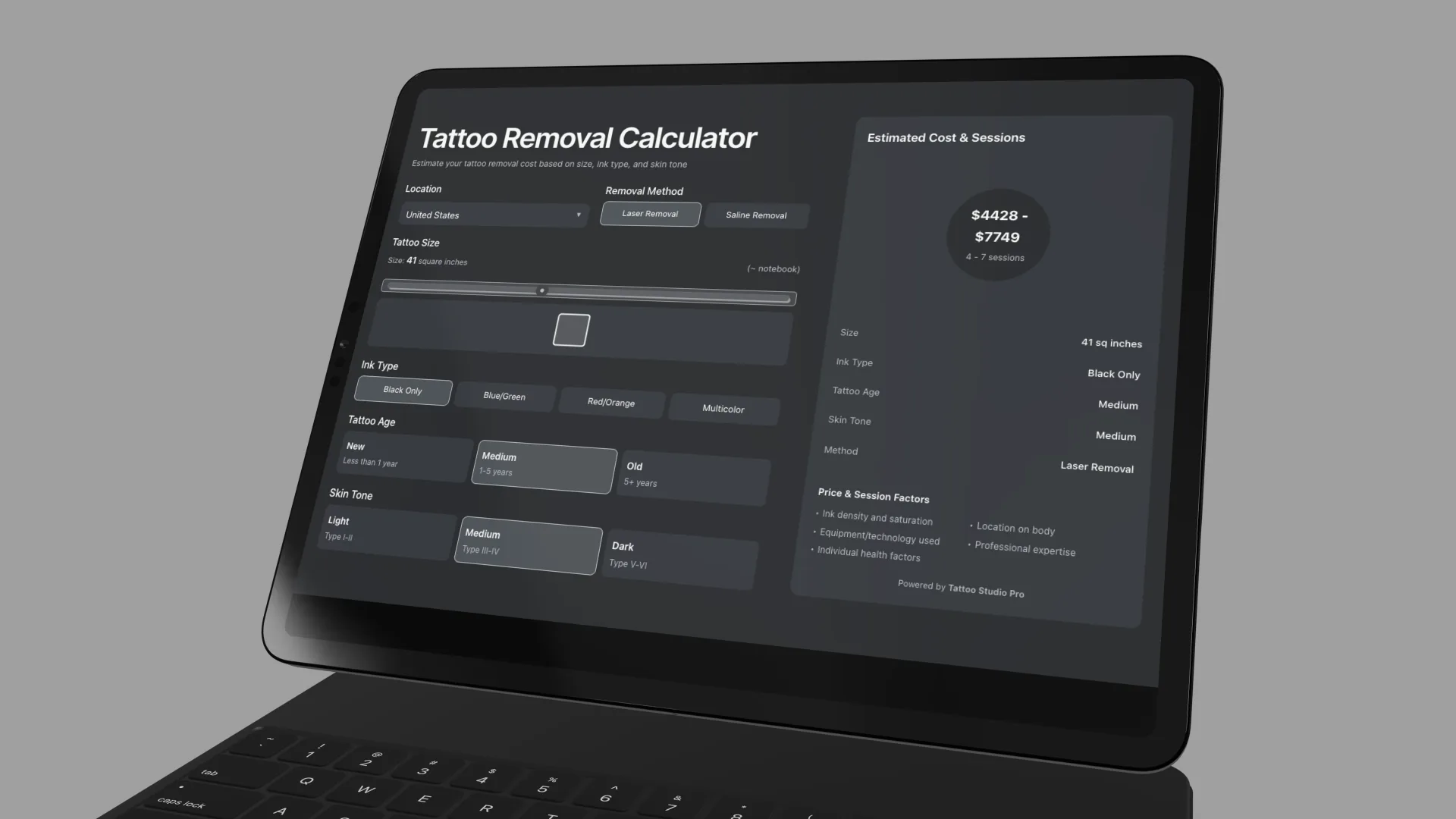
Your total comes down to a number nobody can quote you over the phone: how many sessions your tattoo will take. Our free tattoo removal calculator estimates that from the size, ink colors, age of the tattoo, and your skin tone, for laser or saline removal. No signup.
How to work out your total
Multiply the clinic’s per-session price by the number of sessions, then add the consult and anything the clinic bills separately.
Say a clinic quotes $300 a session and expects 8 sessions. That’s $2,400 before extras. At the ASPS average of $697, the same 8 sessions come to $5,576.
The per-session price mostly follows the clinic and the size of the tattoo. The session count follows the ink and your skin, and it’s the number that swings your total the most. If a clinic offers a package of sessions, ask what happens to the ones you don’t use if the tattoo clears early.
What decides how many sessions you need
A laser shatters the ink into tiny particles, and your body clears them out over the following weeks. The American Academy of Dermatology (AAD) explains why one visit can’t do it: artists layer the ink, and a laser can’t safely break down every layer in one session. Your skin also needs time to heal in between.
In a 2012 AAD release, dermatologist Arielle Kauvar put the usual count at “six to 10 treatments or more”. StatPearls, a medical reference on the NIH bookshelf, says sessions are typically repeated every 6 to 8 weeks. At that pace, eight sessions take close to a year.
Ink color
In the calculator, color moves the session count more than anything else. According to the FDA, green, red, and yellow are the hardest colors to remove, and dark blue and black are the easiest. Each color absorbs a different wavelength of light, so a multicolor piece may need more than one laser.
White ink, flesh-tone ink, and permanent makeup are a special case. The FDA notes these pigments can oxidize and turn black under the laser, and oxidized pigment can’t be treated by laser anymore. If your tattoo has any of them, ask the clinic about a test spot before the full session.
How much ink is in the skin
A dense, fully saturated piece has more ink to clear than light linework. That’s why two tattoos of the same size can come out several sessions apart.
Age of the tattoo
Older tattoos have already faded some. The calculator takes a session off for an old tattoo and adds one for a new one.
Skin tone
Lasers work best when the ink contrasts with the skin around it. On darker skin, clinics use more careful settings to avoid changes in skin pigment, which usually means more sessions. The calculator adds up to two sessions for darker skin tones.
Run your own numbers in the tattoo removal calculator and change one setting at a time. Switching black ink to multicolor shows you how much the color alone adds.
Costs on top of the session fee
The ASPS lists what can show up on the bill besides the physician’s fee:
- Procedure and facility costs
- Anesthesia fees
- Prescriptions
- Medical tests
Health insurance usually won’t help. The ASPS says most plans don’t cover cosmetic procedures, though many plastic surgeons offer financing. Ask about it at the consult.
Ask the clinic what aftercare they recommend between sessions too, so you can budget for it.
Other removal methods
Laser is the most common method, per the FDA. Surgical excision, dermabrasion, and chemical peels are the alternatives, and the ASPS expects excision and dermabrasion to cost more than laser. The calculator also covers saline removal if a clinic near you offers it.
Skip the removal creams. The FDA hasn’t approved any tattoo removal cream or do-it-yourself kit, and the ingredients can’t reach ink in the deeper layer of skin.
Fading a tattoo for a cover-up
If you plan to cover the tattoo with new work, you’re paying to make it lighter, not to make it disappear. Ask the artist doing the cover-up how light it needs to be before you book the laser. That answer tells you how many sessions to plan for.
Then budget for the new tattoo. Our tattoo price guide has typical rates by size, and the tattoo cost calculator gives a ballpark for a specific design.
For removal clinics and studios
If you run a removal clinic, or you’re a studio that sends clients to one, you can put the calculator on your own website. Click “Add this calculator to your website” at the bottom of the tool to get the embed code. Clients see a session estimate before they call you.
FAQs
How much does one laser tattoo removal session cost?
The ASPS average for laser skin treatments, tattoo removal included, is $697 per treatment. That’s the physician’s fee only. Your quote depends on the clinic and the size of the tattoo.
How many sessions does tattoo removal take?
An AAD dermatologist put the usual count at six to 10 treatments or more, a few weeks apart. Ink color, density, age, and skin tone move it up or down. The tattoo removal calculator estimates a range for your tattoo.
Can every tattoo be fully removed?
No. The FDA says complete removal can take many treatments and in some cases isn’t possible. Green, red, and yellow ink are the hardest to clear.
Does insurance cover tattoo removal?
Usually not. The ASPS says most health insurance doesn’t cover cosmetic procedures. Many plastic surgeons offer financing plans instead.
Does laser tattoo removal hurt?
The FDA compares it to snapping a thin rubber band against the skin. If it’s painful, the clinic can put a small amount of numbing cream on first.
Do tattoo removal creams work?
No cream or home kit is FDA approved for tattoo removal. The FDA says their ingredients can’t reach the ink, which sits in the dermis below the outer layer of skin.